Regime-Declared
Mathematics as Survivor Sets
Classical branch: LEM + ZFC + Choice + Completeness
I am a reverse engineer, not a mathematician. This is an experiment in rebuilding a large slice of standard math by tracking what survives explicit constraints.
, Anthony Z.
What this document is
This document reconstructs one coherent branch of mathematics: the one most textbooks assume.
It does not claim inevitability. It claims traceability.
Every stage starts when the previous stage cannot express or verify what this branch needs.
The lens
You will see the same scaffold everywhere:
- Ω: a candidate space with membership criteria.
- C: constraints, treated as operators over Ω.
- R: survivors, R = {ω ∈ Ω | ω passes all active constraints}.
- Check: how membership is tested.
A constraint earns inclusion only if we can: - run it (a decision procedure), - prove it (a derivation in the chosen system), - or apply it as a well-posed variational/PDE condition.
If none of those are available, the document must tag the gap.
What “forced” means here
“Forced” is not one thing. This document separates three reasons constraints appear.
C_consistency: avoids paradox
These constraints are forced by contradiction. If we violate them, we get inconsistency.
Example: Russell-style failures eliminate unrestricted comprehension.
C_specification: fixes the intended object
These constraints select which consistent structure we mean.
Example: Peano-style constraints rule out successor loops and collapse. Those alternatives are consistent. They are not the intended N.
C_capability: preserves theorem families
These constraints are adopted so later constructions remain admissible in the classical style. They are branch points. Rejecting them yields different but consistent mathematics.
This document adopts:
- Classical logic (LEM): admits non-constructive existence proofs.
- Infinity: admits N as a completed object inside the set-theoretic universe.
- Choice: admits Zorn/Tychonoff/Hahn-Banach style results.
- Completeness of R: admits standard real analysis (LUB/Cauchy closure).
Each is tagged when used. Alternatives are noted, not refuted.
Check kinds
Checks are tagged by how they terminate.
Check: decision: terminates with yes/no (parsing, finite algebra, witness verification).Check: semi-decision: may not terminate (enumerable proof search).Check: proof: derivation in the formal system (most theorems).Check: oracle: depends on a chosen evaluator/model (e.g., equality of represented reals).
“COMMIT” means: usable for later stages under this regime. It does not mean: complete foundation, no open questions.
Scope boundary
This document reaches into analysis, algebra, metric structure, and core theorems built from those. It does not pretend to “derive everything”.
Where the lens becomes weaker, it is labeled.
Ω-Construction and the Role of Intuition
This document shows what survives elimination. It does not fully show how the candidate spaces were conceived , because that process is irreducibly creative. Geometric intuition, physical analogy, and pattern recognition are how mathematicians construct Ω. The elimination framework does not replace that creativity; it explains what happens after it, and it gives the eureka moment a precise meaning: the sudden recognition that constraints we already had eliminate everything except one survivor.
Creative modeling and rigorous elimination are two tightly interleaved activities. The framework shown here focuses on the elimination phase and on what survives verification. The creative Ω-construction phase is acknowledged and illustrated at key stages, but is not mechanized by the framework.
At key stages, Ω-CONSTRUCT notes describe the creative act that produced the candidate space:
Ω-CONSTRUCT: geometric: candidate space built from spatial/visual intuition
Ω-CONSTRUCT: algebraic: candidate space built from pattern/structural analogy
Ω-CONSTRUCT: generalization: candidate space built by abstracting a previous stage’s survivors
Ω-CONSTRUCT: failure-driven: candidate space built because the previous Ω was too small
What this document is not
- Not a claim that nature “erases” candidates as a mechanism.
- Not a proof generator.
- Not a neutral reconstruction that compels every foundation to converge.
- Not a replacement for geometric intuition. Intuition constructs Ω. Constraints prune it. Proof stabilizes it.
Status
Terminal: HALT_UNDERDETERMINED at the regime level. This
branch is one path through the branch tree. The document is an audit
trail for that path.
PART I
Foundations
Stage 0: Logic — The Rules of Elimination
Before we can eliminate anything, we need rules for what elimination means. Logic is not a subject to be studied , it is the grammar that makes constraint application possible. We introduce only what is needed to run the elimination machinery.
We want to say things like “if a candidate has property X, it is eliminated.” To do this, we need a minimal language for propositions, truth, and inference. We do not need all of mathematical logic , we need enough to apply constraints.
Stage 0a: Syntax , Well-Formed Formulas
Before we can reason about propositions, we need to know what counts as a well-formed statement. This requires no sets, no types , only an inductive grammar.
An atomic proposition is a symbol (P, Q, R, …). Well-formed formulas (WFFs) are built recursively:
If φ is a WFF, then ¬φ is a WFF.
If φ and ψ are WFFs, then (φ ∧ ψ), (φ ∨ ψ), and (φ → ψ) are WFFs.
Nothing else is a WFF.
This is a finite recursive definition. It needs no prior notion of
collection. Check: decision: given a string, WFF
membership is mechanically decidable by parsing.
Connectives (the operations we need)
NOT (¬): If φ is a WFF, ¬φ is a WFF. Inverts elimination status.
AND (∧): φ ∧ ψ requires joint survival.
OR (∨): φ ∨ ψ requires at least one survivor.
IMPLIES (→): φ → ψ encodes conditional elimination , “if this constraint is active, that candidate is eliminated.”
Note: At this layer, connectives are syntactic. No truth values yet. Truth assignment belongs to Stage 0c.
Stage 0b: Proof System , Inference Rules [FORMAL][FORBID]
Inference rules eliminate invalid reasoning, not invalid propositions. They constrain how we move between WFFs:
Modus ponens: From φ and φ → ψ, derive ψ.
Contradiction (reductio): If assuming φ leads to both ψ and ¬ψ, derive ¬φ.
Note: Universal instantiation (from ∀x, P(x), derive P(a)) requires a domain , it becomes available at Stage 1 once sets exist. Stage 0 is propositional only.
Any chain of reasoning that violates these rules is eliminated. This
is the operating system the rest of the document runs on.
Check: decision: inspect the deduction chain for rule
violations.
R: Valid Deductions
The survivors are all deduction chains that follow the inference rules from accepted premises. Everything else is eliminated.
Stage 0c: Semantics , Classical Bivalence [C_capability]
Ω_meta: This document uses classical logic, which includes:
Bivalence: Every WFF is either true or false. No third option.
Law of Excluded Middle (LEM): For any φ, either φ or ¬φ holds.
These are not forced by contradiction. Intuitionistic logic rejects LEM and produces a different mathematics , constructive mathematics, where existence requires a witness, not just a proof that non-existence leads to contradiction. This is a capability choice. Rejecting it changes which theorems survive in later stages (notably IVT and many existence proofs). Alternative branch: intuitionistic/constructive logic.
Quantifiers (syntax introduced, grounding deferred)
With bivalence adopted, quantifiers get their classical reading:
FOR ALL (∀): ∀x ∈ Ω, P(x) means P holds for every candidate. This is a universal constraint.
THERE EXISTS (∃): ∃x ∈ Ω, P(x) means at least one candidate satisfies P. This is a survival claim.
The epsilon-delta definitions we will encounter later are precisely quantifier structures over candidate spaces. “∀ε > 0, ∃δ > 0 such that...” is a nested elimination: for every tightening of the tolerance, there must exist a window where the constraint is satisfied.
Important: Quantifiers are syntactic at this stage. They presuppose a domain (∀x ∈ what?), which does not exist until Stage 1 provides sets. Universal instantiation (from ∀x P(x), derive P(a)) becomes a valid inference rule only once a domain is available. Until then, quantified formulas are WFFs with no grounded semantics.
What the failure case looks like
Example of eliminated reasoning: “All cats are mammals. Socrates is a
mammal. Therefore Socrates is a cat.” This affirms the consequent , the
inference rule P → Q, Q, therefore P is not valid. The candidate
deduction is eliminated by FORBID on invalid inference patterns.
Check: decision: inspect the deduction chain for rule
violations.
What Breaks
Logic tells us how to reason but gives us nothing to reason about. We have propositions but no objects, no collections, no structure. To build mathematics, we need a way to collect things together and talk about their properties. This forces Stage 1 (given the target of classical mathematics).
Stage 1: Sets — Collecting Candidates
Elimination requires a candidate space Ω. But what is a candidate space? We need a notion of “collection” that is rigorous enough to support membership testing, combining collections, and forming new collections from old ones.
Ω: Candidate Notions of Collection
Naively, a set is any collection of objects sharing a property. This is Cantor’s original idea: for any property P, there is a set {x : P(x)}. This is our initial candidate , unrestricted comprehension.
C₁: Russell’s Paradox [FORMAL][FORBID]
Consider R = {x : x ∉ x}. Is R ∈ R? If yes, then by definition R ∉ R. If no, then by definition R ∈ R. Contradiction.
This eliminates unrestricted comprehension. Not every property defines a set. We need constraints on what collections are allowed to exist.
Check: the contradiction is derivable in pure logic (Stage 0). No
external input needed. This is a FORBID constraint that is fully formal
and mechanically verifiable. Check: proof: the derivation
is finite and inspectable.
R: Axiomatic Set Theory (ZFC)
The survivors are set theories that restrict how sets can be formed. The standard solution is the Zermelo-Fraenkel axioms with Choice (ZFC). Each axiom either enables a necessary construction or blocks a known paradox:
Extensionality: Two sets are equal if and only if they have the same members. (Identity constraint.)
Pairing: For any a, b, the set {a, b} exists. (We can collect two things.)
Union: For any collection of sets, their union exists. (We can merge collections.)
Power set: For any set A, the set of all subsets of A exists. (We can form all sub-collections.)
Separation (restricted comprehension): For any set A and property P, the set {x ∈ A : P(x)} exists. You can filter an existing set, but we cannot conjure a set from an unrestricted property. This is what Russell’s paradox forced.
Replacement: If we can define a function on a set, its image is a set.
Infinity [C_capability]: There exists at least one infinite set. Not forced by paradox , adopted to admit ℕ as an actual completed object, not a schema. Without it, only finite mathematics is available. Alternative branch: finitist mathematics.
Foundation: Every nonempty set has an ∈-minimal element (equivalently: no infinite ∈-descending chains). Eliminates circular and ill-founded membership.
Choice [C_capability]: For any collection of non-empty sets, there exists a function choosing one element from each. Not forced by paradox. Adopted to admit Zorn’s lemma, Tychonoff, Hahn-Banach, and well-ordering results. Alternative branch: constructive mathematics without Choice.
What the failure case looks like
Without Separation, Russell’s paradox crashes the system. Without Infinity, we can build ℕ as a concept but not as a completed set , and Stages 2–11 become unavailable. Without Choice, certain existence proofs (well-ordering of ℝ, Tychonoff’s theorem, some uses of Zorn’s lemma) fail. Each axiom’s absence produces a specific, identifiable loss.
ZFC Axiom Dependency Table
| Axiom | Stack | First needed at | What breaks without it |
|---|---|---|---|
| Extensionality | C_specification | Stage 1 | Set identity undefined |
| Pairing | C_specification | Stage 1 | Cannot form ordered pairs, Cartesian products |
| Union | C_specification | Stage 1 | Cannot merge collections |
| Power Set | C_specification | Stage 2d | Cannot form Dedekind cuts (subsets of ℚ) |
| Separation | C_consistency | Stage 1 | Russell’s paradox crashes the system |
| Replacement | C_specification | Stage 2a | Cannot define arithmetic recursively on ω |
| Infinity | C_capability | Stage 2a | ℕ does not exist as a completed set; only finite math |
| Foundation | C_specification | Stage 1 | Circular membership; non-well-founded sets |
| Choice | C_capability | Stage 3 (Zorn), Stage 11 (Tychonoff) | No well-ordering, no Zorn, no Hahn-Banach |
Essential Set Operations
Intersection: A ∩ B = {x : x ∈ A and x ∈ B}. Joint membership.
Complement: Aᶜ = {x ∈ U : x ∉ A}, relative to a universe U.
Cartesian product: A × B = {(a,b) : a ∈ A, b ∈ B}. Ordered pairs.
Function: f: A → B assigns to each a ∈ A exactly one b ∈ B. A constraint C: Ω → Ω is itself a function.
What Breaks
We can now collect and organize. But we have no numbers. We cannot count, measure, or compare quantities. This forces Stage 2 (given the target).
| ELIMINATED | Unrestricted comprehension (C_consistency: Russell’s paradox). Naive set formation without axioms. |
| SURVIVORS | ZFC axioms as constraint system on set existence. Basic operations: ∩, ∪, ×, complement, function. |
| MISSING | Independence of CH from ZFC. Large cardinal axioms. Alternative foundations (type theory, category theory). Infinity and Choice are C_capability, not C_consistency , alternative branches exist. |
| TERMINAL | COMMIT (SUPPORTED) — this stage’s construction is usable; regime-dependent choices are tagged. |
| CERTAINTY | SUPPORTED |
Stage 2: Numbers , Building the Arithmetic
We need objects that support counting, ordering, and arithmetic. We need to build numbers from the sets we already have.
Stage 2a: Natural Numbers (ℕ)
Ω: Candidate Systems for Counting
We want a set ℕ with a starting element and a successor operation , a system where we can count. The candidate space is all possible set-theoretic constructions that might serve as “the natural numbers.”
C: The Peano Axioms [FORMAL][FORBID] [C_specification]
These axioms specify the intended counting structure. They are not forced by contradiction , a system with loops (like modular arithmetic) is consistent. They define which consistent system we mean by “the natural numbers.”
Eliminate any candidate system that fails:
P1: There exists a distinguished element 0 ∈ ℕ.
P2: There exists a successor function S: ℕ → ℕ.
P3: 0 is not in the range of S. (Nothing comes before the beginning.)
P4: S is injective. (Different numbers have different successors , no collapse.)
P5 (Induction): If a property holds for 0 and is preserved by S, it holds for all of ℕ. (No orphan elements , the chain from 0 reaches everything.)
What gets eliminated and why
A system with a loop (e.g. S(2) = 0): eliminated by P3 + P4 together.
A system with an orphan element unreachable from 0: eliminated by P5
(induction). A system where S(3) = S(5): eliminated by P4 (injectivity).
What survives is (up to isomorphism) uniquely the natural numbers.
Check: proof: categoricity follows from second-order PA
within ZFC.
Qualification: this uniqueness holds for second-order PA or the set-theoretic ω inside ZFC. First-order Peano arithmetic admits nonstandard models , structures that satisfy all first-order axioms but contain elements unreachable by any finite successor chain. Working inside ZFC (Stage 1) pins down the standard model.
Arithmetic on ℕ
Addition and multiplication are defined recursively. Addition: a + 0 = a, a + S(b) = S(a + b). Multiplication: a × 0 = 0, a × S(b) = a × b + a. These are the unique operations compatible with the successor structure. Any other definition would violate the axioms.
Stage 2b: Integers (ℤ) , When Subtraction Breaks
In ℕ, we can add but we cannot always subtract. The equation a + x = b has no solution when b < a. “What is 3 − 5?” has no answer in ℕ. This is a structural gap , the candidate space of “equations solvable in ℕ” has missing survivors.
Construction
Define ℤ as equivalence classes of pairs (a, b) ∈ ℕ × ℕ, where (a, b) represents a − b. Two pairs (a, b) and (c, d) are equivalent when a + d = b + c. The constraint [FORMAL][BALANCE] is that this equivalence must be preserved by addition and multiplication. The survivors are the integers. This is the minimal forced extension of ℕ that makes subtraction total.
Stage 2c: Rationals (ℚ) , When Division Breaks
In ℤ, we can add, subtract, and multiply. But the equation bx = a has no solution when b does not divide a. “What is 3 ÷ 2?” has no answer in ℤ.
Construction
Define ℚ as equivalence classes of pairs (a, b) ∈ ℤ × (ℤ {0}), where (a, b) represents a/b. The equivalence (a, b) ~ (c, d) when ad = bc must be preserved by arithmetic [FORMAL][BALANCE]. The survivors are the rationals , the minimal forced extension.
Stage 2d: Reals (ℝ) , When Completeness Breaks
Ω-CONSTRUCT: geometric — Dedekind’s insight was to visualize the number line and ask: what if we cut it at every point? Each “cut” partitions ℚ into a left half and a right half. The candidate space becomes “all possible cuts of ℚ.” This geometric picture , a knife sliding along a line , is what made the formal construction conceivable. The elimination came after; the picture came first.
The rationals have gaps. The equation x² = 2 has no solution in ℚ. (Proof: assume p/q in lowest terms satisfies p² = 2q². Then p² is even, so p is even, write p = 2k, then 4k² = 2q², so q is even , contradicting “lowest terms.”) More fundamentally, sequences of rationals can converge toward a value that does not exist in ℚ. The candidate space of “limit points of rational Cauchy sequences” has members that are not in ℚ.
C: Completeness [FORMAL][BALANCE] [C_capability]
Eliminate any candidate number system in which there exist Cauchy sequences {aₙ} (where |aₘ − aₙ| → 0) that have no limit in the system. This is the BALANCE invariant: the system must be closed under the limit operation. Note: this is C_capability , adopting completeness gives us the real analysis of Stages 4–10. Constructive real analysis builds different reals with different properties. Alternative branch: constructive/computable reals.
Two constructions satisfy this: Dedekind cuts (partition ℚ into two
halves at each gap) and Cauchy sequence equivalence classes. Both
produce isomorphic systems. The survivor is ℝ. Check: proof
, isomorphism of Dedekind and Cauchy constructions is a standard
theorem. Check: oracle: deciding equality of specific real
numbers depends on the representation and the adopted computable
model.
What the failure case looks like
In ℚ, define aₙ by the recursion aₙ₊₁ = (aₙ + 2/aₙ)/2, starting from a₁ = 1. This is Newton’s method for √2. The sequence is Cauchy in ℚ , the terms get arbitrarily close to each other , but there is no rational number they converge to. The elimination narrows the candidate set, but the survivor does not exist in the space. Completeness is the axiom that prevents this failure mode.
The Completeness Axiom (Least Upper Bound Property)
Equivalently: every non-empty subset of ℝ that is bounded above has a least upper bound in ℝ. This is the single most important structural property for all of analysis.
What Breaks
We now have a complete ordered field. But we have no geometry , no way to talk about distance in multiple dimensions. We also have no rigorous notion of function behavior. While Stage 1 gave us functions as set-theoretic objects, we need the algebraic structures of Stage 3 to organize families of functions , vector spaces, norms, and the tools that make analysis in multiple dimensions possible.
Ω_meta: Transition type: ROUTE [C_capability] , This path (ℝ → Algebra → Metric Spaces → Analysis) is not the only valid one. One could go directly from ℝ to topology/metric spaces and develop analysis without linear algebra first. This document takes the algebraic route because vector spaces and norms are needed for multivariable calculus as developed in Stage 10. Alternative branch: direct to topology.
| ELIMINATED | Unrestricted subtraction in ℕ. Unrestricted division in ℤ. Completeness in ℚ (√2 sequence has no limit). Counting systems with loops or unreachable elements. |
| SURVIVORS | ℕ (Peano axioms), ℤ (additive inverse closure), ℚ (multiplicative inverse closure), ℝ (Cauchy completeness / LUB property). |
| MISSING | Complex numbers (deferred , forced when polynomial algebra breaks). Constructivist objections to LUB/Choice. |
| TERMINAL | COMMIT (SUPPORTED) |
| CERTAINTY | SUPPORTED |
PART II
Structure
Stage 3: Algebra — Structure on Sets
We built the number systems by adding operations and requiring those operations to behave well. Each time: define operations, impose constraints, see what structures survive. Algebra abstracts this pattern. Instead of asking “what numbers exist,” we ask: “what structures can a set carry?”
Ω: Sets Equipped with Operations
Take any set S and equip it with one or more binary operations (functions S × S → S). The candidate space is all possible sets-with-operations. Most are unstructured and useless. Algebraic axioms are the constraints that eliminate the useless ones.
Stage 3a: Groups
C: Group Axioms [FORMAL][FORBID]
Given a set G with operation ∗, eliminate (G, ∗) if any of the following fail:
Closure: For all a, b ∈ G, a ∗ b ∈ G.
Associativity: (a ∗ b) ∗ c = a ∗ (b ∗ c).
Identity: There exists e ∈ G such that e ∗ a = a ∗ e = a for all a.
Inverses: For each a ∈ G, there exists a⁻¹ ∈ G such that a ∗ a⁻¹ = e.
Worked elimination: what fails and why
Consider (ℕ, +). Closure: yes (sum of naturals is natural). Associativity: yes. Identity: yes (0). Inverses: no , there is no natural number n such that 3 + n = 0. The inverse axiom eliminates (ℕ, +) from the group survivor set.
Consider (ℤ, +). Closure: yes. Associativity: yes. Identity: yes (0). Inverses: yes (the inverse of n is −n). All four constraints pass. (ℤ, +) survives. It is a group.
Consider (ℤ, ×). Closure: yes. Associativity: yes. Identity: yes (1). Inverses: no , there is no integer n such that 3 × n = 1. Eliminated. Multiplication on ℤ fails the group test because most elements lack multiplicative inverses.
The group axioms carve out exactly the structures where every
operation is reversible. The inverse axiom is doing the sharpest
elimination , it kills most candidate structures.
Check: decision for finite groups (verify each axiom on the
multiplication table); Check: proof for infinite groups
(derive from definitions).
Stage 3b: Rings and Fields
Groups have one operation. But our number systems have two , addition and multiplication , that interact. We need structures that capture this interaction.
C: Ring Axioms [FORMAL][FORBID]
A ring (R, +, ×) requires: (R, +) is an abelian group, (R, ×) is associative with identity, and × distributes over +. The distribution constraint is the critical one , it binds the two operations together.
Worked elimination: why distribution matters
Without distribution, a(b + c) need not equal ab + ac, and the two operations are unrelated , just two independent structures on the same set. Distribution is the constraint that requires multiplication to respect the additive structure. It is what makes algebraic manipulation (factoring, expanding, simplifying) work. A set with two operations but no distribution is eliminated from the ring survivor set , and all the algebraic techniques we need for calculus are unavailable.
C: Field Axioms [FORMAL][FORBID]
A field is a ring where (R {0}, ×) is also an abelian group , every nonzero element has a multiplicative inverse. This eliminates ℤ (no multiplicative inverses for most elements). The survivors include ℚ, ℝ, ℂ, and finite fields 𝔽ₚ.
Fields are where both addition and multiplication are fully invertible (except division by zero, which is structurally forbidden , assuming 0 has a multiplicative inverse leads to 0 = 1, which collapses the field to a single element).
Stage 3c: Vector Spaces
We want spaces with multiple dimensions , collections of objects that can be scaled and combined. Essential for multivariable calculus and for understanding linear structure.
C: Vector Space Axioms [FORMAL][FORBID]
A vector space over a field F is a set V with vector addition and scalar multiplication satisfying: (V, +) is an abelian group, scalar multiplication distributes over both vector and scalar addition, and scaling by 1 is the identity. Eliminate any (V, F, +, ·) that violates these.
R: Vector Spaces
Survivors: ℝⁿ (the n-dimensional real spaces needed for multivariable calculus), function spaces (essential for analysis), polynomial spaces. The key concept is dimension , the minimum number of vectors needed to span the space. This is a CAPACITY constraint: dim(V) = n means any set of more than n vectors is linearly dependent.
What the failure case looks like
Consider ℝ² with vector addition but scalar multiplication defined as c · (x,y) = (cx, y) , scaling the first component but leaving the second fixed. Then (c + d) · (0, 1) = ((c+d)·0, 1) = (0, 1), while c · (0,1) + d · (0,1) = (0, 1) + (0, 1) = (0, 2). Distributivity of scalar multiplication over scalar addition fails. Eliminated.
Stage 3d: Inner Product Spaces and Norms
Vector spaces give us direction and scaling but no notion of length or angle. To do geometry and calculus in multiple dimensions, we need to measure distance.
C: Inner Product Axioms [FORMAL][FORBID]
An inner product ⟨·,·⟩: V × V → F must satisfy: linearity in the first argument, symmetry (conjugate symmetry for complex fields), and positive definiteness (⟨v,v⟩ > 0 for v ≠ 0). Eliminate any candidate pairing that violates these.
What the failure case looks like
Define ⟨(a,b), (c,d)⟩ = ac − bd on ℝ². Check positive definiteness: ⟨(1,1), (1,1)⟩ = 1 − 1 = 0, but (1,1) ≠ 0. Eliminated. This candidate pairing looks like an inner product but fails the positive definiteness constraint. Without positive definiteness, ‖v‖ = √⟨v,v⟩ can be zero for nonzero vectors, and distance collapses , geometry becomes impossible.
The norm ‖v‖ = √⟨v,v⟩ and distance d(u,v) = ‖u−v‖ are derived from any surviving inner product. With the standard dot product, ℝⁿ becomes Euclidean space , the arena for multivariable calculus.
What Breaks
We have structured spaces where we can measure distance. But we still cannot talk about what happens to functions as inputs change , continuity, slopes, integrals are all undefined. The algebraic structures are the arena; analysis is what happens on stage. This forces Part III (given the target).
| ELIMINATED | Sets-with-operations lacking closure, associativity, identity, or inverses (not groups). (ℕ, +) eliminated , no additive inverses. Rings without distributivity. Candidate inner products failing positive definiteness (⟨(1,1),(1,1)⟩ = 0 example). |
| SURVIVORS | Groups, rings, fields (ℚ, ℝ, 𝔽ₚ). Vector spaces (ℝⁿ, function spaces). Inner product spaces with derived norms and metrics. |
| MISSING | Modules over rings. Algebras. Category-theoretic abstractions. Tensor products. |
| TERMINAL | COMMIT (SUPPORTED) |
| CERTAINTY | SUPPORTED |
PART III
Single-Variable Analysis
Stage 4: Limits — The Collapse Constraint
We built ℝ to fill the gaps in ℚ. But the construction depended on a concept we have not yet formalized: what does it mean for a sequence to “converge”? These questions are about the behavior of candidates under tightening constraints.
Ω_meta: This is exactly what the elimination framework handles.
Stage 4a: Limits of Sequences
Ω: All Possible Limit Claims
Given a sequence {aₙ} in ℝ, the candidate space is all real numbers L that might be the limit. Ω = ℝ.
C: The ε-N Constraint [FORMAL][THRESHOLD]
Eliminate L ∈ Ω if: there exists ε > 0 such that for every N, there exists n > N with |aₙ − L| ≥ ε. L is eliminated if the sequence keeps straying from it no matter how far we go. L survives if, for every tolerance ε, the sequence eventually stays within ε of L permanently.
R: At Most One Survivor [CAPACITY, Derived]
If L₁ and L₂ both survive, then L₁ = L₂. (Proof: if L₁ ≠ L₂, take ε = |L₁ − L₂|/2. The sequence cannot eventually stay within ε of both.) The survivor, if it exists, is unique. This is a CAPACITY constraint emerging from the metric structure of ℝ , it is a theorem, not a primitive constraint: |R| ≤ 1.
What the failure case looks like
The sequence aₙ = (−1)ⁿ has candidate limits L = 1 and L = −1. For L = 1: take ε = 1, the sequence hits −1 infinitely often, so L = 1 is eliminated. For L = −1: take ε = 1, the sequence hits +1 infinitely often, so L = −1 is eliminated. In fact every L ∈ ℝ is eliminated. The survivor set is empty. The sequence diverges. HALT: no survivor.
Stage 4b: Limits of Functions
C: The ε-δ Constraint [FORMAL][THRESHOLD]
lim_{x→x₀} f(x) = L means: for every ε > 0, there exists δ > 0 such that 0 < |x − x₀| < δ implies |f(x) − L| < ε.
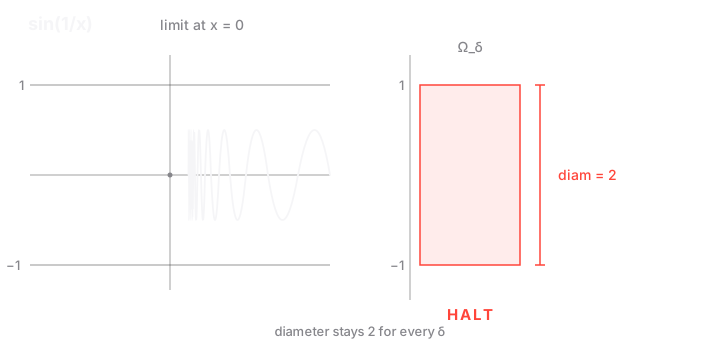
The eliminative reading: build Ω_δ = {f(x) : 0 < |x − x₀| < δ}. As δ shrinks, does the diameter of Ω_δ collapse to zero? If yes, the survivor is the limit. If no, no limit exists.
What the failure case looks like
f(x) = sin(1/x) near x = 0. For any δ > 0, the set Ω_δ = {sin(1/x) : 0 < |x| < δ} equals the entire interval [−1, 1]. The diameter is permanently 2. No collapse. No limit. The function oscillates too wildly near 0 for any single value to survive elimination.
Stage 4c: Limit Algebra
If lim aₙ = L and lim bₙ = M, then lim(aₙ + bₙ) = L + M, lim(aₙbₙ) = LM, and lim(aₙ/bₙ) = L/M (when M ≠ 0). These are theorems, not axioms , the constraint structure of ℝ requires arithmetic to pass through limits.
What Breaks
We can say what values functions approach. But we cannot distinguish functions that reach their target values from those that do not. This forces continuity (given the target).
Stage 5: Continuity , Functions That Honor Their Limits
Limits describe where a function is heading. Continuity demands that the function actually arrives. A function can have a limit at x₀ without being continuous there. We need a constraint that eliminates these failures.
C: Continuity Constraint [FORMAL][FORBID]
f is continuous at x₀ if and only if lim_{x→x₀} f(x) = f(x₀). Three conditions must hold: f(x₀) is defined, lim_{x→x₀} f(x) exists, and they are equal. Eliminate functions where any condition fails.
What the failure cases look like
Case 1, hole: f(x) = x²/x. The limit as x → 0 is 0, but f(0) is undefined (0/0). First condition fails. Eliminated.
Case 2, jump: f(x) = ⌊x⌋ (floor function) at x = 1. The left limit is 0, the right limit is 1. The limit does not exist. Second condition fails. Eliminated.
Case 3, removable discontinuity: f(x) = 1 for x ≠ 0, f(0) = 5. The limit as x → 0 is 1, but f(0) = 5 ≠ 1. Third condition fails. Eliminated.
Each failure mode violates a different condition. The continuity
constraint classifies discontinuities by which condition breaks.
Check: proof (via epsilon-delta argument) or
Check: oracle (numerical evaluation at a point).
R: Continuous Functions and Their Power
Intermediate Value Theorem: If f is continuous on [a,b] and f(a) < c < f(b), then there exists x₀ ∈ (a,b) with f(x₀) = c. Continuous functions cannot skip values. (Consequence of completeness , the gaps we filled in Stage 2d.)
Extreme Value Theorem: If f is continuous on [a,b], then f attains a maximum and minimum on [a,b].
These are consequences of constraints already in place, not extra postulates.
What Breaks
Continuity says nothing about slope. A function can be continuous everywhere and differentiable nowhere (Weierstrass, 1872). The question “how fast is f changing?” requires a new concept. This forces Stage 6 (given the target).
Stage 6: Differentiation , The Slope Survivor
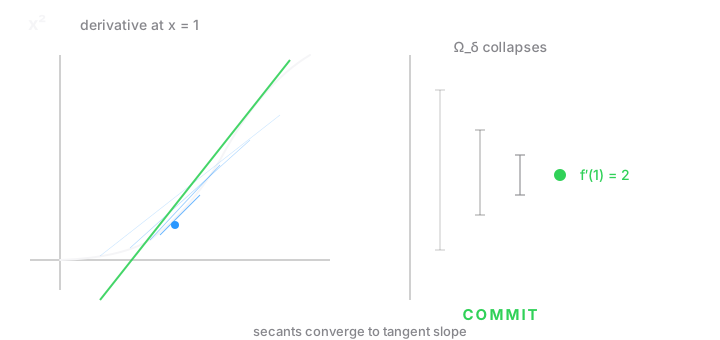
Ω-CONSTRUCT: geometric — The secant-to-tangent visualization is not decoration. It is the geometric Ω-construction: draw two points on a curve, connect them, then slide one toward the other. The set of all secant slopes is Ω. The visual collapse of the secant line to a tangent line is the elimination. The picture is the candidate space.
We want the slope of a curve at a point. Slope is rise over run , it needs two points. For a single point, we ask: as the second point approaches the first, do the secant slopes collapse to a single value?
Ω: Candidate Slopes
For f: ℝ → ℝ and a point x₀, define the candidate slope set: Ω_δ = { (f(x₀+h) − f(x₀))/h : 0 < |h| < δ }.
C: Collapse Constraint [FORMAL][THRESHOLD]
f is differentiable at x₀ if and only if lim_{h→0} (f(x₀+h) − f(x₀))/h exists. As δ → 0, does diam(Ω_δ) → 0? If yes, the unique survivor is f’(x₀).
Worked example: f(x) = x² at x₀ = 1
Secant slope = ((1+h)² − 1)/h = (2h + h²)/h = 2 + h. As h → 0 from
either side, the slopes approach 2. The diameter of Ω_δ = {2 + h : 0
< |h| < δ} is 2δ, which goes to 0. Survivor: f’(1) = 2. COMMIT.
Check: proof: for polynomials, the limit computation is
algebraic and terminates. For general functions,
Check: oracle: verifying differentiability at a point
depends on the function representation.
Failure case: f(x) = |x| at x₀ = 0
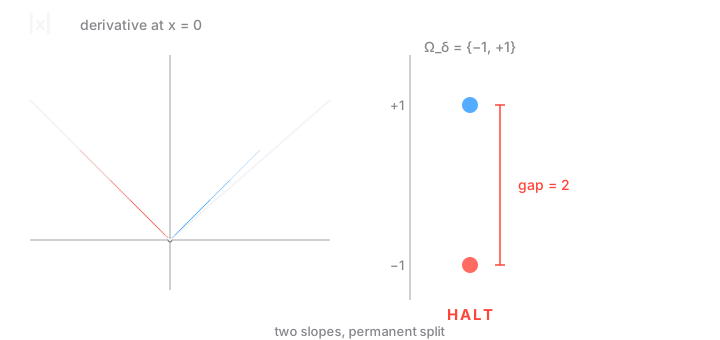
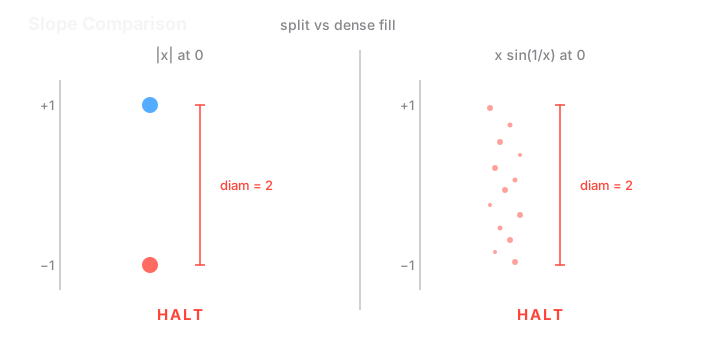
Secant slope = |h|/h. For h > 0: slope = +1. For h < 0: slope = −1. The candidate set Ω_δ = {−1, +1} for every δ > 0. Diameter permanently 2. No collapse. No survivor. The function is not differentiable at 0. HALT: permanent positive diameter.
Failure case: f(x) = x·sin(1/x) at x₀ = 0
Here f(0) = 0, so the secant slope is sin(1/h), which oscillates between −1 and +1 as h → 0. The candidate set diameter stays at 2 but the behavior is different from |x| , it’s not a clean split into two values, it’s dense oscillation. A computational checker would classify this as OSCILLATION rather than NO_COLLAPSE , same terminal state (HALT), different failure signature.
R: The Derivative and Its Rules
The derivative f’(x₀) is the unique survivor. The differentiation rules are theorems about how constraints compose:
Sum rule: (f+g)’ = f’ + g’. Slope elimination distributes over addition.
Product rule: (fg)’ = f’g + fg’. Elimination interacts through the product structure.
Chain rule: (f∘g)’ = (f’∘g)·g’. Nested eliminations compose.
Quotient rule: (f/g)’ = (f’g − fg’)/g². Derived from product rule + inverse.
Mean Value Theorem
If f is continuous on [a,b] and differentiable on (a,b), then there exists c ∈ (a,b) with f’(c) = (f(b)−f(a))/(b−a). The average slope must be achieved as an instantaneous slope somewhere. This bridges local (derivative) and global (total change) information.
What Breaks
Differentiation gives rates of change. The inverse question , “given a rate, recover the total” , requires integration. This forces Stage 7 (given the target).
| ELIMINATED | Secant slopes that fail to converge (|x| at 0: permanent {−1, +1} split). Oscillating slopes (x·sin(1/x) at 0: dense oscillation). Candidate slopes outside the collapsing interval. |
| SURVIVORS | Derivative as unique slope survivor. Differentiation rules. Mean Value Theorem. Higher derivatives by iteration. |
| MISSING | Functions differentiable everywhere but pathological. Smoothness classes. Differential equations (deferred). |
| TERMINAL | COMMIT (SUPPORTED) |
| CERTAINTY | SUPPORTED |
Stage 7: Integration , Accumulation by Exhaustion
Ω-CONSTRUCT: geometric — Riemann’s insight was a specific Ω-construction: what if area candidates are bounded between upper and lower step-function approximations? The exhaustion method was elimination , refine the steps until the gap closes. But the choice of what to exhaust (upper vs lower rectangles, domain-partitioned) was the creative act. Lebesgue later constructed a different Ω by partitioning the range instead of the domain , a fundamentally different geometric picture that survives where Riemann’s fails.
We want total accumulated quantity , area under a curve, total distance from velocity. Differentiation gave us the rate; integration recovers the whole.
Ω: Candidate Area Values
For f: [a,b] → ℝ (bounded), the candidate space for “area under f” is all real numbers. We need constraints that eliminate all but the correct value.
Why Integration is Structurally Harder Than Differentiation
The derivative eliminates from a one-dimensional candidate set (slopes at a point) by checking collapse as h → 0. Integration eliminates from a one-dimensional candidate set (area values) but the constraint operates over the entire interval [a,b] simultaneously. Each partition refines the approximation across all subintervals at once. The derivative is a local collapse; the integral is a global exhaustion. This is why integrability is a stronger condition , the function’s behavior everywhere on [a,b] contributes to whether the gap closes.
Stage 7a: Riemann Integration
The Partition Approach
Partition [a,b] into subintervals. On each, the lower sum L(P) uses the infimum of f, the upper sum U(P) uses the supremum. For any partition: L(P) ≤ true area ≤ U(P).
Worked example: f(x) = x on [0, 1]
We know the answer should be 1/2 (triangle area). Watch the elimination produce it.
Partition [0,1] into n equal subintervals of width 1/n. On [k/n, (k+1)/n], the infimum is k/n and the supremum is (k+1)/n.
Lower sum: L(Pₙ) = ∑_{k=0}^{n-1} (k/n)(1/n) = (1/n²) · ∑_{k=0}^{n-1} k = (n-1)/(2n).
Upper sum: U(Pₙ) = ∑_{k=0}^{n-1} ((k+1)/n)(1/n) = (1/n²) · ∑_{k=1}^{n} k = (n+1)/(2n).
Gap: U(Pₙ) − L(Pₙ) = (n+1)/(2n) − (n−1)/(2n) = 1/n.
n=2: L = 1/4, U = 3/4, gap = 1/2. Candidates in [0.25, 0.75].
n=4: L = 3/8, U = 5/8, gap = 1/4. Candidates in [0.375, 0.625].
n=10: L = 9/20, U = 11/20, gap = 1/10. Candidates in [0.45, 0.55].
n=100: L = 99/200, U = 101/200, gap = 1/100. Candidates in [0.495, 0.505].
The gap → 0 as n → ∞. Both sums → 1/2. The unique survivor is ∫₀¹ x dx = 1/2. COMMIT.
This is the same collapse structure as the derivative , a shrinking candidate interval , but operating globally across the whole domain rather than locally at a point.
C: Upper-Lower Collapse [FORMAL][THRESHOLD]
Eliminate candidate values below sup{L(P)} or above inf{U(P)}. The constraint: as partitions refine, does U(P) − L(P) → 0?
If sup L(P) = inf U(P), the unique survivor is ∫ₐᵇ f(x)dx. If the gap has a permanent positive floor, the function is not Riemann integrable , the elimination halts with an interval of survivors rather than a point.
What the failure case looks like
The Dirichlet function: f(x) = 1 if x ∈ ℚ, f(x) = 0 if x ∉ ℚ. On any subinterval, the infimum is 0 (irrationals are dense) and the supremum is 1 (rationals are dense). Every lower sum is 0. Every upper sum is 1. The gap is permanently 1. No collapse. Not Riemann integrable.
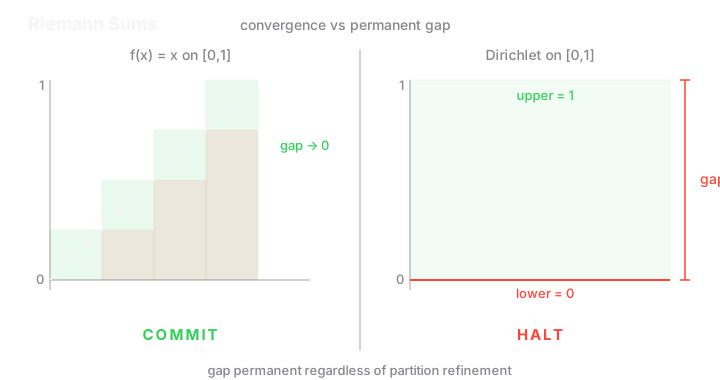
Note: The Dirichlet function is Lebesgue integrable with integral 0 (since ℚ has Lebesgue measure zero). The failure is specific to Riemann’s Ω-construction (domain partition). Lebesgue’s Ω-construction (range partition) produces a different survivor set.
This is a structurally different failure from the derivative cases. The derivative of |x| fails because slopes split into two values. The Dirichlet function’s integral fails because the function is everywhere discontinuous , upper and lower approximations cannot be forced to agree.
Stage 7b: The Fundamental Theorem of Calculus
The structural link between differentiation and integration , the deepest theorem in single-variable calculus.
FTC Part 1: If f is continuous on [a,b] and F(x) = ∫ₐˣ f(t)dt, then F’(x) = f(x). Integration followed by differentiation recovers the original function.
FTC Part 2: If F’ = f, then ∫ₐᵇ f(x)dx = F(b) − F(a). Total accumulation equals net change of any antiderivative. This converts an infinite process (Riemann sum limit) into a finite calculation.
The FTC is a consequence of the constraints already in place , limits, continuity, differentiation, completeness.
Ω_meta: The elimination framework makes the derivation chain explicit.
What Breaks
Riemann integration works for continuous and monotone functions but
fails for highly discontinuous ones (Dirichlet function). Lebesgue
integration redefines Ω by partitioning the range rather than the domain
, a different creative Ω-construction
(Ω-CONSTRUCT: failure-driven) that survives in cases where
Riemann’s fails.
Ω_meta: Beyond current scope, but the framework extends naturally.
Stage 8: Sequences and Series , Infinite Sums Under Constraint
We need infinite sums , Taylor series, power series , to connect local derivative information to global function behavior. An infinite sum is a limit of partial sums, and limits can fail.
Ω: All Partial Sum Sequences
Given {aₙ}, define Sₙ = a₁ + ... + aₙ. The series ∑aₙ converges if {Sₙ} has a limit. Same collapse constraint from Stage 4.
Convergence Tests as Constraints
Divergence test [FORBID]: If aₙ ↛ 0, eliminate from the convergent set. (Necessary, not sufficient.)
Comparison test [THRESHOLD]: If |aₙ| ≤ bₙ and ∑bₙ converges, then ∑aₙ converges.
Ratio test [THRESHOLD]: If |aₙ₊₁/aₙ| → r < 1, converges. If r > 1, diverges. If r = 1: HALT UNDERDETERMINED , the test has no discriminating power.
Integral test [THRESHOLD]: Links series convergence to integral convergence, connecting Stage 7 back to Stage 8.
What the failure case looks like
The harmonic series ∑1/n: the divergence test passes (1/n → 0), but the series diverges. The partial sums grow without bound. This shows that the divergence test is a necessary condition only , passing it does not guarantee survival. The comparison and integral tests provide the finer discrimination needed.
Stage 8b: Power Series and Taylor Series
∑aₙ(x−c)ⁿ converges on (c−R, c+R) where R = 1/lim sup |aₙ|^{1/n}. The
radius R is a CAPACITY constraint on the domain [Derived: follows from
the root test applied to the coefficient sequence].
Check: proof.
A Taylor series ∑(f⁽ⁿ⁾(c)/n!)(x−c)ⁿ may converge to the wrong function. The function e^{−1/x²} (with f(0) = 0) has all derivatives zero at the origin , its Taylor series is identically 0, but the function is not. The constraint for Taylor representation: the remainder Rₙ(x) → 0. Functions where this holds are analytic , the survivors of the Taylor representation constraint.
Stage 8c: Uniform Convergence
C: Uniform Convergence [FORMAL][BALANCE]
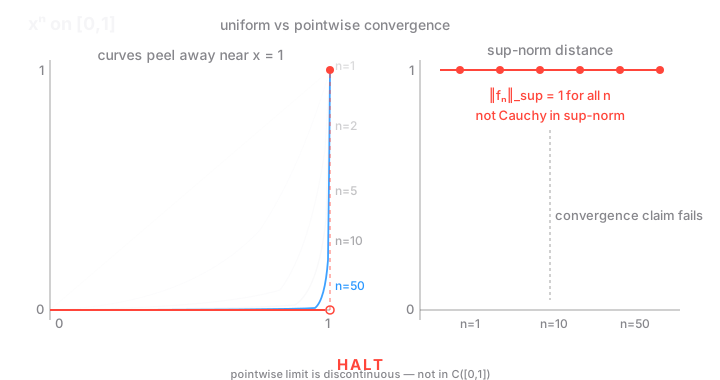
fₙ → f uniformly if: for every ε > 0, there exists N such that for all n > N and all x in the domain: |fₙ(x) − f(x)| < ε. The key: N works for all x simultaneously. This is a BALANCE invariant , the convergence rate is stable across the entire domain.
What the failure case looks like
fₙ(x) = xⁿ on [0,1]. Each fₙ is continuous. The pointwise limit is f(x) = 0 for x ∈ [0,1) and f(1) = 1 , a discontinuous function. The claim “fₙ → f uniformly” is eliminated: near x = 1, we need larger and larger N to get within ε, and no single N works for all x. The BALANCE invariant is violated , convergence rate depends on position. Uniform convergence preserves continuity; pointwise convergence does not.
What Breaks
Single-variable calculus is complete: limits, continuity, differentiation, integration, series, convergence theory. But the world has more than one dimension. This forces Part IV (given the target).
| ELIMINATED | Series where aₙ ↛ 0. Harmonic series (passes divergence test, fails anyway). Taylor representations where Rₙ ↛ 0 (e^{−1/x²} example). Pointwise convergence claims where uniform convergence is needed (xⁿ example). |
| SURVIVORS | Convergent series with classified type. Power series with determined radius. Analytic functions. Uniform convergence preserving continuity and integrability. |
| MISSING | Fourier series (requires inner product on function spaces). Lebesgue integration for limit interchange. Summability methods. |
| TERMINAL | COMMIT (SUPPORTED) |
| CERTAINTY | SUPPORTED |
PART IV
Multivariable Analysis and Beyond
Stage 9: Metric Spaces , Distance as Foundation
Ω-CONSTRUCT: generalization — Fréchet’s insight (1906) was to ask: what if distance itself is a candidate? Instead of assuming Euclidean distance and proving theorems about it, he elevated the concept of distance to an object that could be varied , and then asked which properties a distance function must have for the ε-δ machinery to work. This is Ω-construction at a meta-level: the candidate space is all possible notions of distance, and the metric axioms are the constraints.
Every concept in Stages 4–8 depends on |x − y| < ε. In higher dimensions and function spaces, we need to abstract distance itself.
Ω: All Candidate Distance Functions
Given a set X, a candidate distance function is any d: X × X → ℝ.
C: Metric Axioms [FORMAL][FORBID]
Eliminate d if any fail:
Positivity: d(x,y) ≥ 0, with d(x,y) = 0 iff x = y.
Symmetry: d(x,y) = d(y,x).
Triangle inequality: d(x,z) ≤ d(x,y) + d(y,z).
What the failure cases look like
d(x,y) = (x − y)². This is positive and symmetric. But triangle inequality: d(0,2) = 4, while d(0,1) + d(1,2) = 1 + 1 = 2. Since 4 > 2, the triangle inequality fails. Eliminated. Squaring distances breaks the metric structure , this is why we use |x − y|, not (x − y)², as the standard distance.
d(x,y) = 0 for all x, y. Positivity fails: d(x,y) = 0 does not imply
x = y. Eliminated. A distance function that cannot distinguish points is
useless for analysis. Check: decision for concrete
candidate functions (evaluate the three axioms on specific inputs);
Check: proof for general metric spaces (derive from
definitions).
R: Metric Spaces
Survivors: ℝⁿ with Euclidean distance, function spaces with sup-norm or L² norm, discrete metric spaces. The metric axioms capture exactly the distance properties needed to run the ε-δ machinery in any setting.
Completeness generalizes: a metric space is complete if every Cauchy sequence converges within it. ℝ is complete. ℚ is not. Banach spaces are complete normed spaces; Hilbert spaces are complete inner product spaces.
Worked example: the sup-norm metric on functions
Let X = C([0,1]), the set of continuous functions from [0,1] to ℝ. Define d(f,g) = sup_{x ∈ [0,1]} |f(x) − g(x)| , the largest vertical gap between the two functions.
Check the metric axioms:
Positivity: |f(x) − g(x)| ≥ 0 for all x, so sup ≥ 0. And sup = 0 iff |f(x) − g(x)| = 0 for all x iff f = g. ✓
Symmetry: |f(x) − g(x)| = |g(x) − f(x)| for all x, so sup is the same. ✓
Triangle inequality: |f(x) − h(x)| ≤ |f(x) − g(x)| + |g(x) − h(x)| for each x (triangle inequality on ℝ). Taking sup over x: d(f,h) ≤ d(f,g) + d(g,h). ✓
All three axioms pass. (C([0,1]), d_sup) is a metric space. The ε-δ machinery from Stages 4–8 now works for functions: “fₙ converges to f” means d(fₙ, f) → 0, which means sup|fₙ(x) − f(x)| → 0 , this is exactly uniform convergence from Stage 8c. The abstraction doesn’t add new content; it reveals that uniform convergence was already a metric concept.
Why a different “distance” fails on functions
Try d(f,g) = |f(0) − g(0)| , distance measured only at x = 0. Positivity fails: let f(x) = 0 and g(x) = x. Then d(f,g) = |0 − 0| = 0, but f ≠ g. Eliminated. A distance that only checks one point cannot distinguish functions that differ elsewhere. This is why the sup-norm checks all points simultaneously.
Open Sets and Topology
An open ball B(x, ε) = {y : d(x,y) < ε}. A set U is open if every point has an open ball around it contained in U. Open sets formalize neighborhoods , the regions within which ε-δ arguments operate. The collection of open sets defines the topology.
Why this abstraction is forced, not optional
The ε-δ machinery from Stages 4–8 used |x − y| on ℝ. The function space example shows it working with sup|f − g| on C([0,1]). The proofs are identical , because they depend only on the three metric axioms. Without abstracting to metric spaces, we would need to re-derive every limit theorem for each new distance formula. The abstraction is forced by the need to reuse analysis beyond ℝⁿ.
This also explains Stage 8c retroactively: uniform convergence was the natural convergence in the sup-norm metric. The topology of pointwise convergence on C([0,1]) is induced by the product topology (or equivalently, a family of seminorms), not by any single metric compatible with the full function space. In concrete terms: pointwise convergence means convergence at every single point separately, with no requirement that the rate of convergence be the same across points. (For example, fₙ(x) = xⁿ converges pointwise to the discontinuous function that is 0 on [0,1) and 1 at x=1, but no single metric on C([0,1]) induces exactly this convergence.) This is weaker than sup-norm convergence, which demands a single uniform rate , which is why it fails to preserve continuity. The metric framework reveals that uniform convergence is not an ad hoc strengthening but the structurally correct notion of distance between functions.
Stage 10: Multivariable Calculus
Physical quantities depend on multiple variables. We need to extend limits, continuity, differentiation, and integration to functions f: ℝⁿ → ℝᵐ.
Stage 10a: Multivariable Limits and Continuity
For f: ℝⁿ → ℝ, lim_{x→x₀} f(x) = L means: for every ε > 0, there exists δ > 0 such that ‖x − x₀‖ < δ implies |f(x) − L| < ε. Same collapse structure as Stage 4, with absolute value replaced by Euclidean norm.
The critical new phenomenon
In one dimension, there are two directions of approach. In ℝⁿ, infinitely many. A function can have a limit along every straight line through x₀ but fail to have a limit overall.
Worked failure case
f(x,y) = xy/(x² + y²), f(0,0) = 0. Along any line y = mx: f = mx²/(x² + m²x²) = m/(1 + m²), a constant depending on m. Different lines give different limits. Along y = x: limit is 1/2. Along y = 0: limit is 0. The limits along straight lines disagree, so the overall limit does not exist. The multivariable constraint is strictly stronger , elimination must work along all paths, including curved ones.
Stage 10b: Partial Derivatives
∂f/∂xᵢ applies the single-variable derivative from Stage 6 while holding other variables fixed. But partial derivatives existing does not guarantee differentiability , a function can have all partial derivatives at x₀ and still not be continuous there.
This is the key gap between single-variable and multivariable calculus. In one dimension, the derivative captures all the information about local behavior (there are only two directions). In ℝⁿ, partial derivatives capture slope along n axis directions but miss infinitely many others.
Worked example: partials exist, function is not differentiable
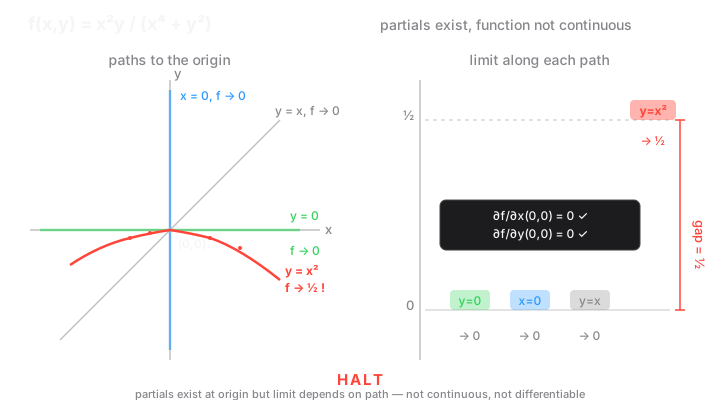
Define f(x,y) = x²y/(x⁴ + y²) for (x,y) ≠ (0,0), f(0,0) = 0.
Step 1 , compute partial derivatives at origin:
∂f/∂x at (0,0): lim_{h→0} (f(h,0) − f(0,0))/h = lim_{h→0} 0/h = 0. (Because f(h,0) = h²·0/(h⁴ + 0) = 0.)
∂f/∂y at (0,0): lim_{h→0} (f(0,h) − f(0,0))/h = lim_{h→0} 0/h = 0. (Because f(0,h) = 0·h/(0 + h²) = 0.)
Both partial derivatives exist and equal 0. The Jacobian matrix, if the function were differentiable, would be [0, 0].
Step 2 , test along the curve y = x²:
f(x, x²) = x²·x²/(x⁴ + x⁴) = x⁴/(2x⁴) = 1/2 for all x ≠ 0.
Along this parabolic path, f = 1/2 everywhere , but f(0,0) = 0. The function is not even continuous at the origin. Partial derivatives exist (and equal 0), but the function jumps from 0 to 1/2 along a curved approach.
Step 3 , test the total derivative definition:
If f were differentiable with Jacobian A = [0, 0], the residual would be:
|f(h,k) − f(0,0) − [0,0]·(h,k)| / ‖(h,k)‖ = |f(h,k)| / √(h² + k²)
Along y = x²: |f(x,x²)| / √(x² + x⁴) = (1/2) / √(x² + x⁴) → ∞ as x → 0.
The residual does not vanish , it blows up. The linear map A = [0, 0] is eliminated. And no other linear map can save it, because the function is not even continuous. The candidate space of linear approximations has no survivor. HALT: not differentiable.
This is the multivariable analogue of the |x| failure in Stage 6, but more insidious: partial derivatives can lull us into thinking the function is well-behaved, while curved approaches reveal the failure. The total derivative catches this; partials alone do not.
Stage 10c: Total Derivative
C: Linear Approximation Collapse [FORMAL][THRESHOLD]
f: ℝⁿ → ℝᵐ is differentiable at x₀ if there exists a linear map A: ℝⁿ → ℝᵐ such that lim_{h→0} ‖f(x₀+h) − f(x₀) − Ah‖ / ‖h‖ = 0. The candidate space is all linear maps A. The constraint eliminates every A for which the residual does not vanish faster than ‖h‖.
If a survivor exists, it is unique , the Jacobian matrix. The total derivative guarantees the linear approximation works in every direction simultaneously, which is strictly stronger than having all partial derivatives.
Worked success case: f(x,y) = x² + 3xy at (1,2)
Partial derivatives: ∂f/∂x = 2x + 3y. At (1,2): 2(1) + 3(2) = 8. ∂f/∂y = 3x. At (1,2): 3(1) = 3. Candidate Jacobian: A = [8, 3].
Expand: f(1+h, 2+k) = (1+h)² + 3(1+h)(2+k) = 1 + 2h + h² + 6 + 3k + 6h + 3hk = 7 + 8h + 3k + h² + 3hk.
f(1,2) = 7. Linear approximation: 7 + 8h + 3k. Residual: |f(1+h,2+k) − 7 − 8h − 3k| / √(h²+k²) = |h² + 3hk| / √(h²+k²).
Bound: |h² + 3hk| ≤ |h|² + 3|h||k| ≤ 4(h² + k²) = 4·‖(h,k)‖². So the ratio ≤ 4·‖(h,k)‖ → 0 as (h,k) → (0,0). The residual vanishes. A = [8, 3] survives. COMMIT.
Stage 10d: The Major Theorems
Chain rule: D(f∘g)(x₀) = Df(g(x₀)) · Dg(x₀). Nested eliminations compose via Jacobian matrix multiplication.
Inverse Function Theorem: If Df(x₀) is invertible (det ≠ 0), then f is locally invertible. The FORBID constraint: det(Df) = 0 eliminates the candidate , the map collapses dimensions.
Implicit Function Theorem: If F(x,y) = 0 and the relevant partial Jacobian is invertible, the implicit function exists locally. A survival theorem , the implicit function is the survivor of the constraint equations.
What the failure case looks like (Inverse Function Theorem)
f(x,y) = (x², y²). The Jacobian is [[2x, 0], [0, 2y]], with determinant 4xy. At the origin, det = 0. The map f sends the entire cross-shaped set {(x,0)} ∪ {(0,y)} to the single point (0,0) , it collapses dimensions. The FORBID constraint (det = 0 → eliminated) fires, and indeed f is not locally invertible at (0,0): every point near (0,0) in the range has four preimages (±√a, ±√b), not one.
Stage 10e: Multiple Integration
Integration over regions in ℝⁿ follows the same exhaustion principle as Stage 7. Fubini’s theorem: the multiple integral can be computed as iterated single integrals (order doesn’t matter, under appropriate conditions).
Stage 10f: Fundamental Theorems in Higher Dimensions
The single-variable FTC generalizes to a family of theorems:
Green’s Theorem: Line integral around a closed curve = double integral over enclosed region.
Stokes’ Theorem: Integral of a form over a boundary = integral of its exterior derivative over the interior. The master generalization.
Divergence Theorem: Surface integral of a vector field = volume integral of its divergence.
All instances of one structural principle: integration of a derivative over a region equals integration of the function over the boundary. The FTC, Green’s, Stokes’, and Divergence Theorem are the same theorem at different dimensions.
| ELIMINATED | d(x,y) = (x−y)² (triangle inequality fails). d(f,g) = |f(0)−g(0)| (can’t distinguish functions). Multivariable limit claims failing along paths (xy/(x²+y²)). Partial-derivative-only differentiability claims (x²y/(x⁴+y²) , partials exist, not differentiable, not even continuous along y=x²). Linear approximations with non-vanishing residual. Jacobian-singular invertibility claims (f = (x²,y²) at origin). |
| SURVIVORS | Metric spaces with verified axioms (sup-norm on C([a,b]) worked). Total derivative as unique linear approximation survivor (x² + 3xy worked). Inverse and Implicit Function Theorems. Multiple integration via Fubini. Generalized Stokes’ theorem. |
| MISSING | Differential forms (rigorous treatment). Manifolds. Lebesgue integration in ℝⁿ. Measure theory. Functional analysis. |
| TERMINAL | COMMIT (SUPPORTED) |
| CERTAINTY | SUPPORTED |
Stage 11: Toward Real Analysis , Tightening the Foundations
Throughout Stages 4–10, we used completeness and properties of continuous functions without always proving every claim from first principles. Real analysis revisits the foundations with full rigor and handles pathological cases.
Compactness
A subset K ⊆ ℝⁿ is compact if every open cover has a finite subcover. In ℝⁿ (by Heine-Borel): K is compact iff K is closed and bounded.
Compactness is a finiteness constraint [CAPACITY]: it guarantees that infinite processes (covers, sequences) can be reduced to finite ones. This is what makes the Extreme Value Theorem, uniform continuity, and many convergence theorems work.
Worked example: Bolzano-Weierstrass in action
Ω-CONSTRUCT: geometric — The bisection picture is deeply visual: imagine a bounded interval on the number line. At each step we cut it in half and keep the half that still has infinitely many sequence terms trapped inside it. The interval shrinks, the trapped terms are forced closer together, and completeness guarantees the shrinking cage converges to a point. The Ω-construction is “all possible subsequential limits”; the bisection is the elimination; the geometry makes both visible.
Claim: every bounded sequence in ℝ has a convergent subsequence. This is sequential compactness , the sequence version of the open cover definition.
Take aₙ = sin(n). This sequence is bounded in [−1, 1] but does not converge (it wanders quasi-randomly). Bolzano-Weierstrass guarantees a convergent subsequence exists.
The elimination procedure: [−1, 1] contains infinitely many terms. Bisect into [−1, 0] and [0, 1]. At least one half contains infinitely many terms , pick that half. Bisect again. Continue. At each step, the interval halves in width and still contains infinitely many terms. The nested intervals collapse: their widths are 2, 1, 1/2, 1/4, ... → 0. By completeness (Stage 2d), the intersection is a single point L. The subsequence selected from successive intervals converges to L.
This is the Ω→C→R pattern applied to subsequences: Ω = all subsequences, C = the nested bisection constraint selects subsequences trapped in shrinking intervals, R = the limit point L forced to exist by completeness. The CAPACITY constraint (bounded) ensures we start with a finite interval. Completeness (C_capability: BALANCE) ensures the shrinking intervals converge to something in ℝ.
What the failure case looks like: ℚ
Run the same bisection procedure in ℚ. Take a sequence of rationals converging toward √2 , for instance the Newton iteration aₙ₊₁ = (aₙ + 2/aₙ)/2 from Stage 2d. Every term is rational. The sequence is bounded in [1, 2]. The bisection procedure works perfectly: nested intervals shrink, each containing infinitely many terms.
But √2 ∉ ℚ. The intersection of the nested intervals, computed in ℚ, is empty. The elimination narrows the candidate set to nothing. Bolzano-Weierstrass fails in ℚ because ℚ is not complete , the BALANCE invariant (completeness) is absent. The subsequence is Cauchy but has no limit in the space. This is the same failure mode as Stage 2d, now visible at the level of compactness.
Non-compactness failure
The open interval (0,1) is bounded but not closed , not compact. f(x) = 1/x is continuous on (0,1) but has no maximum , it blows up near 0. The Extreme Value Theorem fails because the domain is not compact. Compactness is not a technicality; it is the constraint that prevents escape to infinity.
Alternatively: the sequence aₙ = 1/n is in (0,1) and bounded, but its limit 0 is not in (0,1). The space leaks. Closure plugs the leak. Compactness = bounded + closed = no escape upward and no escape through the boundary.
Connectedness
A set is connected if it cannot be separated into two non-empty open subsets. Connected subsets of ℝ are exactly the intervals.
What the failure case looks like
The set [0,1] ∪ [2,3] is disconnected , separated by the gap (1,2). Define f = 0 on [0,1], f = 1 on [2,3]. This is continuous on its domain, takes values 0 and 1, but never takes value 1/2. The IVT fails because the domain is disconnected. Connectedness is the constraint that prevents skipping values.
Completeness Revisited
Every major theorem in analysis traces to completeness. Bolzano-Weierstrass, the Cauchy criterion, Nested Interval Property , all equivalent to completeness. They are different expressions of the same structural fact: ℝ has no gaps.
Ω_meta: From this framework’s perspective, completeness is the BALANCE invariant ensuring elimination terminates. In ℚ, Cauchy sequences converge toward gaps , the elimination narrows the candidate set but the survivor does not exist in the space. Completeness prevents this failure.
It is C_capability: adopted to make the analysis machinery of Stages 4–10 function. Without it, we get constructive real analysis , different but consistent.
Spaces of Functions
C([a,b]) , continuous functions from [a,b] to ℝ , is a complete metric space under the sup-norm (verified in Stage 9). The analysis machinery applies to functions as objects.
Completeness of the function space: what it means
If {fₙ} is a Cauchy sequence in C([a,b]) under the sup-norm , meaning sup|fₙ(x) − fₘ(x)| → 0 as n,m → ∞ , then there exists a continuous function f such that fₙ → f uniformly. The limit stays in the space. No gaps in the function space, just as no gaps in ℝ.
What the failure case looks like
The sequence fₙ(x) = xⁿ on [0,1]. Each fₙ is continuous. The pointwise limit is f(x) = 0 for x ∈ [0,1) and f(1) = 1 , discontinuous. But the claim “{fₙ} converges in (C([0,1]), d_sup)” is what fails: the sequence is not Cauchy under the sup-norm (d(fₙ, fₘ) = sup|xⁿ − xᵐ| does not converge to 0, because the functions peel apart near x = 1 at different rates). Completeness is not violated , the convergence claim was never valid in the first place. The sup-norm metric correctly identifies this as a non-convergent sequence. The discontinuous pointwise limit is not “eliminated by C([0,1])” , it was never a candidate in that space. What is eliminated is the claim that {fₙ} is Cauchy under d_sup.
Arzelà-Ascoli provides compactness criteria for function sets: uniformly bounded + equicontinuous ⟹ sequentially compact. Stone-Weierstrass shows polynomials are dense in C([a,b]) , every continuous function can be uniformly approximated by polynomials.
Ω_meta: This is where the framework comes full circle: the spaces we built to study functions are themselves arenas where the same elimination machinery operates. Compactness, completeness, convergence , the same concepts, the same constraint shapes, applied to a higher-level Ω.
| ELIMINATED | Non-compact domains where EVT fails ((0,1) with 1/x). Disconnected domains where IVT fails ([0,1] ∪ [2,3]). Incomplete spaces where Bolzano-Weierstrass fails (ℚ , bisection converges to gap). Pointwise convergence claims in function spaces (xⁿ , convergence claim fails under sup-norm, C([0,1])). |
| SURVIVORS | Compactness as CAPACITY constraint (finite subcovers, Bolzano-Weierstrass via bisection). Connectedness as separation constraint. Completeness equivalences (BW ⟺ Cauchy criterion ⟺ Nested Intervals ⟺ LUB). Complete function space C([a,b]) under sup-norm. Arzelà-Ascoli, Stone-Weierstrass. |
| MISSING | Lebesgue integration and measure theory. Banach/Hilbert space theory. Spectral theory. Distribution theory. Manifolds and differential geometry. |
| TERMINAL | COMMIT (SUPPORTED) |
| CERTAINTY | SUPPORTED (within declared regime) |
Closing: The Structure of the Journey
Every stage followed the same pattern:
1. A problem that current tools cannot solve.
2. A candidate space of possible solutions.
3. Constraints that eliminate inadequate candidates.
4. Survivors that become the new tools.
5. A new problem that forces the next stage.
The progression:
Logic was needed to state constraints.
Sets were needed to form candidate spaces.
Numbers were needed to measure and compute.
Algebra was needed to capture structure.
Limits were needed because completeness demanded them.
Continuity was needed because limits alone don’t prevent gaps.
Differentiation was needed because continuity doesn’t capture rate.
Integration was needed because differentiation’s inverse was missing.
Series were needed because functions demanded infinite representations.
Metric spaces were needed because ℝ was not the only arena.
Multivariable calculus was needed because the world has more than one dimension.
Real analysis was needed because the earlier stages left gaps in rigor.
Nothing was introduced unless it was forced by contradiction (C_consistency), required to specify the intended model (C_specification), or explicitly adopted for capability (C_capability). Every stage starts when the previous stage cannot express or verify what the target regime needs. Change the regime, and we get different but consistent mathematics.
If it was not forced, it was not introduced. If it was adopted, the branch point is tagged. “Forced” always means “forced given the regime.”
Master Elimination Log
ELIMINATED:
  - Unrestricted comprehension (C_consistency: Russell's paradox)
  - Number systems without closure under subtraction/division (C_specification)
  - Sets-with-operations lacking algebraic structure (C_specification)
  - Candidate limits/slopes/areas failing collapse (C_specification)
  - Distance functions violating metric axioms (C_specification)
  - Multivariable approximations with non-vanishing residual (C_specification)
SURVIVORS:
  - ZFC set theory [Infinity and Choice are C_capability]
  - Classical logic [C_capability]
  - ℕ → ℤ → ℚ → ℝ number tower [Completeness is C_capability]
  - Groups, rings, fields, vector spaces [C_specification]
  - Limits via ε-δ collapse, continuous functions with IVT/EVT
  - Derivatives as slope survivors, Riemann integral via exhaustion, FTC
  - Convergent series, metric spaces
  - Total derivative and Jacobian, generalized Stokes' theorem
  - Compactness and connectedness, complete function spaces
MISSING CONSTRAINTS:
  - Lebesgue integration and measure theory
  - Manifolds and differential geometry
  - Complex analysis, functional analysis, algebraic topology
  - Differential equations, Fourier analysis
  - Probability theory (measure-theoretic)
  - Alternative branches: constructive analysis, homotopy type theory, predicative foundations
TERMINAL:
  - HALT UNDERDETERMINED --- the regime is one branch; alternatives exist at every C_capability choicepoint
CERTAINTY:
  - SUPPORTED (within declared regime)
Appendix A: Constraint Shape Contracts
Each constraint shape has a minimal operational contract. These are not just labels , they define proof obligations.
| Shape | Contract | Signature |
|---|---|---|
| FORBID | Predicate P must be false for all eliminated candidates. | P: Ω → {0, 1}; eliminate ω where P(ω) = 1 |
| THRESHOLD | Quantified ε-style constraint with tightening parameter. Survival requires passing for all values of the tightening parameter. | ∀ε > 0, ∃witness such that constraint(ε, witness) holds |
| BALANCE | Invariant I must be preserved under refinement or extension. Eliminate candidates that violate I. | I: Ω → {preserved, violated}; eliminate ω where I(ω) = violated |
| CAPACITY | Cardinality or dimension bound on the survivor set. | |R| ≤ N or dim(R) ≤ N |
| ORDER | Precedence relation on execution or construction steps. Never eliminates directly , restricts valid sequences. | require p₁ precedes p₂; reject sequences violating order |
| ROUTE | Path-dependent branching. Branches must merge unless terminated. | route ω to Ω_left else Ω_right; merge or terminate each branch |
Appendix B: Stage Transition Types
Not every stage transition is forced by contradiction. Transitions are tagged:
| Transition | Type | Reason |
|---|---|---|
| Logic → Sets | BREAK: C_consistency |
Cannot form candidate spaces without collections |
| Sets → Numbers | BREAK: C_specification |
Sets exist but contain no arithmetic objects |
| ℕ → ℤ → ℚ | BREAK: C_specification |
Closure under subtraction/division |
| ℚ → ℝ | BREAK: C_capability |
Completeness is adopted, not forced |
| ℝ → Algebra | BREAK: ROUTE [C_capability] |
Could go directly to topology; algebra chosen for this roadmap |
| Algebra → Limits | BREAK: C_specification |
Structured spaces exist but function behavior is undefined |
| Limits → Continuity | BREAK: C_specification |
Limits don’t distinguish arrival from approach |
| Continuity → Differentiation | BREAK: C_specification |
Continuity doesn’t capture rate |
| Differentiation → Integration | BREAK: C_specification |
Inverse operation missing |
| Single-variable → Metric Spaces | BREAK: C_capability |
Could stay in ℝ; abstraction adopted for reuse |
| Metric Spaces → Multivariable | BREAK: C_specification |
World has more than one dimension |
| Multivariable → Real Analysis | BREAK: C_specification |
Earlier stages left rigor gaps |
Appendix C: Check Kinds Reference
| Kind | Description | Termination | Example |
|---|---|---|---|
decision |
Terminates with yes/no | Always | WFF parsing (Stage 0a), finite group membership |
semi-decision |
May not terminate | Not guaranteed | Enumerating theorems of PA |
proof |
Derivation in the formal system | Depends on proof search | Most theorems in Stages 1–11 |
oracle |
Depends on adopted evaluator or model | External | Real number equality, general continuity |
Appendix D: Visual Failure Log
Seven diagrams are embedded inline at their corresponding stages: sin(1/x) limit (Stage 4b), |x| derivative (Stage 6), slope comparison (Stage 6), x² derivative success (Stage 6), Dirichlet vs f(x)=x Riemann sums (Stage 7), uniform vs pointwise convergence (Stage 8c), and partials-exist-but-discontinuous (Stage 10b).